By Widhibek
Adapted for NightSkyIndonesia.com
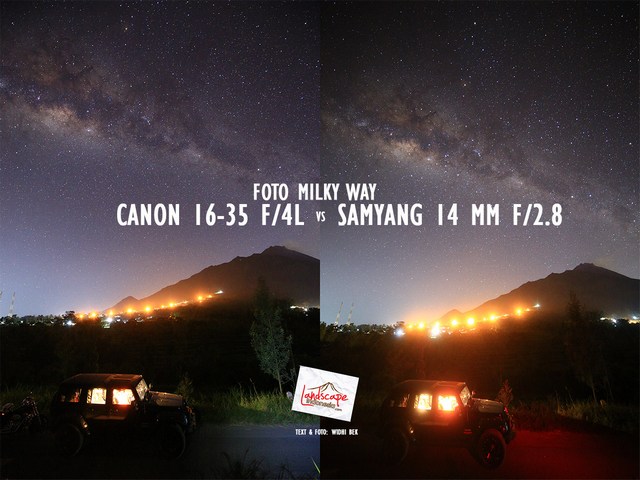
Which lens is better for Milky Way photography—the trusty Samyang 14mm f/2.8 that has accompanied me on many night hunts, or the recently added Canon 16-35mm f/4L? A few days ago, I brought both lenses to capture the night beauty at Mount Merapi. Here’s a comparison based on my observations and personal experience, not technical jargon.
Samyang 14mm f/2.8
Advantages:
- Wider and broader field of view (14mm focal length)
- Wider aperture at f/2.8
- Affordable price (~3.5-4 million IDR)
- Sharp results
- Can use lower ISO due to wider aperture
- Very suitable for landscapes and astrophotography due to ultra-wide angle and aperture
Disadvantages:
- Cannot use filters (not critical for Milky Way)
- Manual focus only (okay since Milky Way focus is manual anyway)
- Not so great when shooting against bright lights
- Strong distortion, especially horizontal lines bending like a mustache
Canon 16-35mm f/4L
Advantages:
- Image Stabilizer (IS), though less useful for tripod work in Milky Way
- Supports 77mm filters (CPL, GND, UV, ND)
- Flexible zoom range 16-35mm for composition
- Fast autofocus
- Better flare control than Samyang 14mm
- Less distortion than Samyang 14mm
- Sharp output
- Versatile: landscape, portrait, travel
Disadvantages:
- About 3x pricier than Samyang 14mm
- Smaller aperture than Samyang 14mm
- Narrower field of view than Samyang 14mm
- Requires higher ISO to compensate smaller aperture
Distortion Test
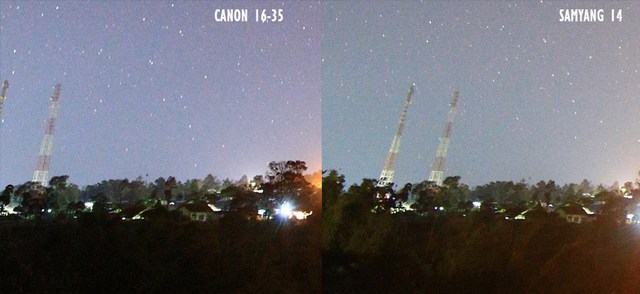
Canon 16-35mm produces much friendlier distortion than Samyang 14mm.
Flare Test
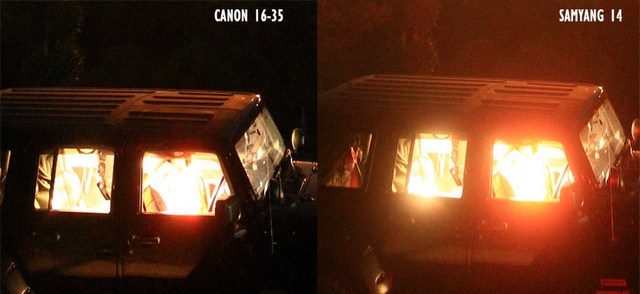
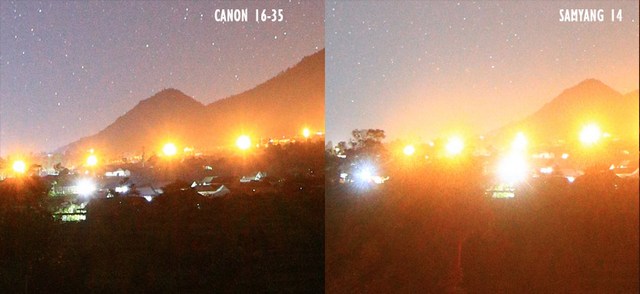
Canon 16-35mm outperforms Samyang 14mm in handling bright light sources.
Milky Way Test
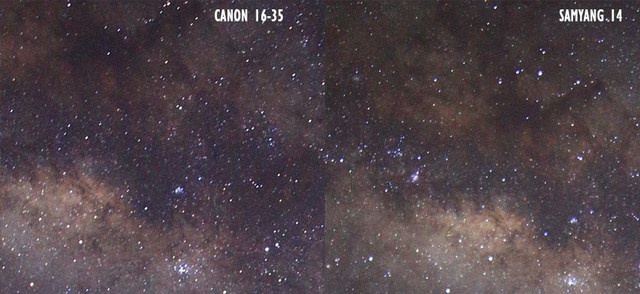
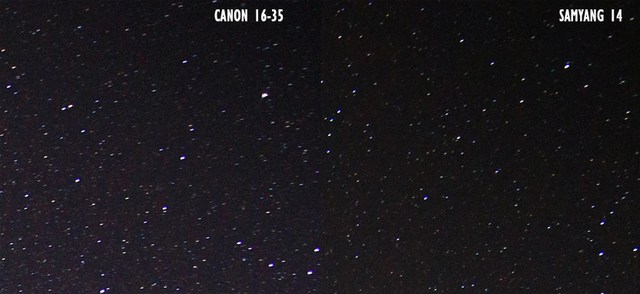
Both lenses deliver equally sharp Milky Way images.
Edge Sharpness
100% cropped edge comparison shows little difference.
Summary
For pure landscape and Milky Way photography, Samyang 14mm offers most advantages: wider aperture, wider field of view, affordability. But for broader use beyond night shots, Canon 16-35mm’s filter capability and IS make it more versatile.
If weight and packing mandate choosing one for long trips like mountain treks, Canon 16-35mm is my pick. For accessible locations, I wouldn’t hesitate to carry both.
Conclusion
Both lenses are worthy Milky Way options. Samyang 14mm takes precedence for dedicated Milky Way shooters; Canon 16-35mm is my choice for combined landscape day and night use.
NightSkyIndonesia.com encourages photographers to pick lenses fitting their unique needs balancing sharpness, flexibility, and budget.
Leave a Reply